The Bigamist Two Quebec Writers, a Translation, and a Friendship

by Linda Leith
15 February 2025
I recently translated a French-language novel by the immigrant Quebec author, translator, and publisher Felicia Mihali. The story of how we came to work together on the English version of the book—and what transpired during the translating process—may interest readers curious about how this came to be.
Last March Felicia sent me her novel, La bigame, asking me to consider translating it into English. “This is my story,” she said; “the story of my divorce after I arrived in Canada.”
Three weeks later, after reading the novel and drafting a translation of the first two chapters, to see if I was able to find the voice in which I could tell her story effectively, I wrote back to let her know I liked her novel—and that I’d prepare an application for a translation grant. Felicia was delighted, in fact “doubly thrilled, first because it’s one of my books,” she wrote in April, “and second, because you master the language of love, wisdom, and gentleness in a life full of ups and downs.”
Modesty advises me not to include these words—and the very touching paragraph that follows; I do so because she was so dismayed later on, when she’d read my translation:
“And there is a third very personal reason,” she added.
As I have told you, or maybe not, you have been a model to me for a long time, since I was coming to attend Blue Met every day, all day long.
Then I read your books, and you published me in English out of the blue. You are the symbol of a different world, by age, upbringing, origin, someone I was taking as an example in everything. I’ve always wanted to work with you, be close to you, and learn more.
Well, to me this book will be always a proof of our meeting in this world. In a way, I feel like I’ve done what I dreamed of doing in Canada. Being close and learning from someone like Linda Leith.
Thank you.
I got to work, and sent her the draft translation a few months later, and that took her aback, for it wasn’t in her own voice, and it didn’t, she thought, sound like her.
That voice is mine, and I’d understood she’d wanted me to use my voice in The Bigamist. I thought that’s why she’d wanted me to be the one to translate her book.
Had I misunderstood?
The Bigamist is not, I should add, my first book-length translation: I had previously translated Montreal writer Louis Gauthier’s Voyage en Irlande avec un parapluie. I didn’t know Louis Gauthier particularly well, having been introduced to his book by a Hungarian friend in Montreal. The process of translating Voyage involved far less personal interaction than The Bigamist. Felicia’s comments on my translatlon and our long acquaintance, together with a recent study by the distinguished American translator Damian Searls inspire me to explore what matters most in La bigame, the role my friendship with Felicia has played, and the ways in which that history has played out in the immigrant margins of contemporary Quebec writing.
II
Two Quebec Writers
A journalist in Bucharest as a young woman, Felicia immigrated to Montreal with her Romanian husband in 2000.
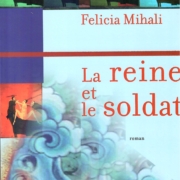
André Vanasse, of the venerable Montreal literary house XYZ Éditeur published her first novel in French—Un pays du fromage—in 2002, prompting one Quebec reviewer to compare it to early work by Marie-Claire Blais.
I met Felicia within a couple of years of her arrival, having launched the multilingual Blue Metropolis Montreal International Festival. She was publishing a literary blog, Terra Nova, at the time, and she chose to include a piece about my memoir, Épouser la Hongrie.
I appreciated Felicia’s writing, her international literary interests, and her multilingualism. Not only had she learned Mandarin, Dutch and English, in addition to French, but she had published three novels in Romanian—among them Tara brânzei, which she had now rewritten in French as Un pays du fromage—before emigrating and was now working towards an advanced degree in comparative literature.
The publication of The Bigamist marks a new stage in our literary friendship.
Felicia and I have lived different lives, but our paths have crossed many times in our work as writers, literary translators, and publishers. And there is some overlap between her story and mine, mostly because I have been an immigrant, too.
Born in Belfast, I moved to London as a child, then Basel, where I spoke German and the Basler dialect. My family and I landed in Montreal in 1963, and I later studied in Paris and then in London, where I married a Hungarian refugee. We settled in Montreal, where we had three sons before moving to Budapest in 1990. I know what it’s like to live in in a foreign country, in other words, and in a foreign language.
I’d had an academic career before launching Blue Met—the first festival took place in April 1999—and I was ready for another new start when I resigned in 2010 and then, in 2011, founded Linda Leith Publishing in 2011. Felicia’s career and my own continued to intersect, and I published several of Felicia’s wry accounts of immigrant life on my online forum, Salon .ll., and then chose The Darling of Kandahar, which Felicia wrote in English, as the novel that would launch LLP’s publishing program in April 2012.
Felica founded her own literary press, Éditions Hashtag, in 2018, and has been publishing poetry, fiction and her translations into French from English—including two LLP titles—as well as from Romanian and Ukrainian. Most recently, in 2023, LLP published the English translation of Un pays du fromage.
André Vanasse, who is one of the pioneers of contemporary Quebec literature both at XYZ Éditeur and at the influential periodical Lettres québécoises. was among the significant influences in both Felicia Mihali’s career and my own. He fostered new voices in Quebec literature, publishing and promoting the work of immigrants like Felicia and, in an unprecedented move, including one of my first articles on Anglo-Québec writing in Lettrés québécoises and, later on, commissioning a substantial article about the early years of Blue Metropolis, when its multilingualism had created friction with the Union des écrivaines et écrivains québécois (UNEQ). He went out of his way, moreover, to help Blue Met find common ground with UNEQ, its Festival de la littérature and its then-president, the late Bruno Roy, an author published by XYZ Éditeur.
Another influential figure in my career was Lise Bergevin at Leméac Éditeur, who published Épouser la Hongrie. Like André, Lise was an open-minded and active supporter of Blue Metropolis, sitting on the programming committee in the festival’s formative years. After I published an account of Montreal’s postwar literary history—Writing in the Time of Nationalism—in 2010, Leméac published the French translation.
La très regrettée Lise Bergevin passed away in 2019.
III
A Translation
La bigame tells the story of an unnamed young woman who has a history not entirely unlike that of Felicia Mihali—and who is making a new life herself in Montreal with her Romanian husband, Aron. Her immigrant story is inseparable from the romance that develops between her and Roman, the divorced man she meets in Montreal.
The Bigamist tells the story of an immigrant torn between the Romanian world she grew up in and the vividly recreated Montreal in which she now lives. And of a woman who is torn, too, between her husband Aron and Roman, who has a house in suburban Laval. She has left her career as a Bucharest journalist behind her by the time she finds herself wrestling with the impossibility of choosing between these two men.
While the novel is most clearly about how she relates to the old world and the new—and to Aron, whom she married in Romania, and Roman, the great love of her new life. That is not all, however, for the novel is also about a woman reinventing herself as a writer. As the narrator tells her readers, early on, “I’d come to this country to become a writer.”
The story of becoming a writer is one I knew from my own experience. In 1990, when I moved to Budapest with my Hungarian husband and our sons, I was too busy with my academic career and my family to find time for writing. Budapest appealed to me for many reasons—I’d been there several times before. Uppermost in my mind, though, was that I knew I’d have more time in Budapest—where I was on leave of absence from my teaching duties—and I wanted to take the opportunity to start writing in Hungary.
I had no way of knowing the effect that displacement would have on me, or the ways in which that foreign city would inspire me. But, by the time I returned to Montreal in the summer of 1992, I had the manuscript of my first novel in my suitcase.
Felicia is no doubt right in her conviction that the voice of the narrator in my translation—The Bigamist—differs from the voice in which she wrote in La bigame.
And my translation is certainly not faithful to every word Felicia wrote, in large part because English works so differently from French, and you have to say things differently in English if you hope to have anything like the same effect.
Felicia knows this, of course; she understands there must be differences.
What struck her most was the confident tone of my translation.
I had not found the original lacking in confidence, and I translated the book I read. The Bigamist is not only Felicia’s book, in other words; it’s mine too, and my translation is based on my reading of the novel.
In The Philosophy of Translation, Daniel Searls sees a translator as “a reader who re-creates their own path through the textual world of a book.” Searls is Impatient with philosophical discussions about whether translation ‘reflects’ or instead ‘transforms’ what’s in the original; he prefers to think of a translation that is developed, as if it were a photograph, and he’s impatient with critics who judge translations by how “faithful” they may be. “All translators are faithful,” he argues, “but to different things”:
Translators are faithful to whatever they feel is most important. What they feel must be preserved in the move from one language to another.
In a review of Searls’s book, the translator and critic Johannes Göransson writes that “the most far-reaching consequence of understanding translation as a kind of reading” is that “no one translates a text; they translate their reading of the text, and everyone has different reading experiences.”
IV
A Literary Friendship
What I find intriguing, even breathtaking, in The Bigamist, is the appeal of each of the narrator’s worlds—and of each of the men she loves. As readers, we may figure the narrator will eventually choose between these two worlds—and between Aron and Roman. I was staggered by the difficulty she evidently has in making her choice, and I wouldn’t be surprised if readers, too, find that surprising and, at time, outrageous.
While this inability to choose seems to be at the core of the book, there’s much more to this novel.
Indecisive and guilt-ridden as the narrator is in her thinking about Aron and Roman, this is one decisive woman when it comes to the life she wants for herself.
If she suffers from a lack of self-confidence, that is not how she comes across. On the contrary, it’s crystal clear not only that she wants to change her life, but that she knows how to do so. That’s what matters most to her, and that’s what she sets about doing.
As translator, it’s part of my job to honour the work in front of me—and to be true, in this case, to what I discover about the narrator’s impatience with—and her abiding love for—Aron, as well as her burning desire for Roman, along with her reservations about the suburb where she moves in with him.
It’s also part of my job to be true not only to her frustration with the life she led in Romania, but also to her sharp response to Montreal and the immigrant life, which are more vivid and visceral than in any of the stories set in Montreal in decades. Being true to what matters most to her may be the most important part of my job.
This is a woman who was fed up with journalism, and who is now actively preparing to become a writer.
Not only is she madly in love with books—the novel is full of quotations from and allusions to the many writers she’s reading, from Edith Wharton and Günter Grass to Hanif Kureishi and Yo Ma, and from Mircea Cartarescu and Salman Rushdie to Elfriede Jelinek—but she first meets Roman at a memorable meeting of the Romanian-Canadian Writers’ Association, of which she is a member.
For most of the novel, moreover, she devotes her time to a program of studies at the Université de Montréal leading to her Master’s degree in post-colonial literature.
Writers and writing are what matter most to this narrator.
I translated the book based on my reading, and my reading may well be informed by my own experience of being torn between one world and another.
I don’t know the world of Bucharest, but I do know something about the not entirely different world of Budapest, having spent several long stretches of time there over a period of twenty years.
I don’t pretend to any knowledge of either Aron or Roman except what I read in the novel, but I know what it’s like to want to write.
What I see as crucial in The Bigamist is not only its focus on irreconcilable differences, but its bookishness: its literary antecedents, its literary allusions and the literary aspirations the narrator expresses repeatedly—and acts on throughout the novel.
That’s my reading.
I was moved by the note Felicia wrote to me last April, and I told her so, commenting as well on my enjoyment of her novel. I’d laughed especially, I said, at her deliciously mischievous account of the writers’ association meeting (I myself have been part of a few writers’ associations) and at Aron’s complaints about the food in Montreal grocery stores; I’d heard the same thing for years from Hungarian immigrants.
“Maybe one day one of us (or both of us),” I wrote, “will write something about how this collaboration came to be. It has the makings of a good story, a very Canadian story, I daresay.”
I sent Felicia a revised draft late last summer. She admitted she’d been a little destabilized at first by the translation because, “I found it omitted details I’d counted on to create the mindset of a woman who is doubtful and fearful, questioning herself every step of the way. Lacking in confidence, in short.”
That was when she was reading the original together with my translation, doing a word-for-word comparison. Knowing the role the translator plays, and the fact that the translator’s choices may fail to satisfy the author, she stopped reading the two so closely together, and, she explained, “…then just read your version.”
And I love it. It’s a lot like the Linda Leith of her memoirs, with her concise, assured style. Isn’t that a win, to transform the little immigrant into a confident woman?
If our long association was tested by my translation of The Bigamist, Felicia and I are now working together more happily than ever before.
Early this year, she wrote me again. “I really liked your memoir,” she said,
…the tone, the atmosphere. After Marrying Hungary, I did not doubt that you would know how best to tell my story with grace, family, work, love, disappointment, despair, and finally goodness.
When I was nominating André Vanasse for the Ordre national du Québec last fall, I learned that these applications require a supporting nominator, and I asked Felicia to step up. She readily agreed.
A year ago, in the winter of 2024, Felicia accepted the role of Co-publisher of LLP-LLÉ, and she has been moving confidently into that role ever since.
The Bigamist is published by LLP in March, 2025.
And Felicia and I hope to attend André’s investment into the Ordre national du Québec this summer.
–ends—
Notes
Published by Éditions Hashtag, 2022
2 Travels with an Umbrella: An Irish Journey (Signature Editions, 2000) was nominated for both the QWF Prize in Translation and the John Glassco Prize in Literary Translation.
3 Translated by Aline Apostolska (Montréal: Leméac Éditeur, 2004).
4 Linda Leith Publishing (LLP), is also known in French as Linda Leith Éditions or (LLÉ).
5 A Ramshackle Home, translated by Judith Weisz Woodsworth (LLP, 2023)
- Épouser la Hongrie was translated into Serbian (trans. Aleksandra Mankic) before appearing in English as Marrying Hungary (Winnipeg: Signature Edition, 2008).
7, Écrire au temps du nationalisme, translated by André Roy (Montréal, Leméac Éditeur, 2014).
7 https://www.ronslate.com/on-the-philosophy-of-translation-by-damion-searles/
Bio:
Montreal writer translator and publisher Linda Leith is the author of 8 works of fiction and non-fiction, most recently The Girl from Dream City: A Literary Life (University of Regina Press, 2021).
Email: leith.lindaleith@gmail.com ; Website: www.lindaleithauthor.com